To monitor your student RDP session, you need to install those two modules:
- Classroom Spy Professional Console - can be installed anywhere in your network
- Classroom Spy Agent - Must be installed on TS (RDP) Server
Installing the Classroom Spy Agent on TS (RDP) Server
Application can monitor individual TS (RDP) sessions. In this case agent has to be installed on a Terminal Services Server using the same procedure as described for local network installation.
When installing the agent you can choose to make all TS (RDP) sessions accessible also via Cloud connection by selecting "Use direct or cloud connection", which allows you to monitor sessions over the Internet. Cloud license is subscription based. Read more about installation to the Cloud.
You need to add only server to the monitoring console because sessions will appear automatically.
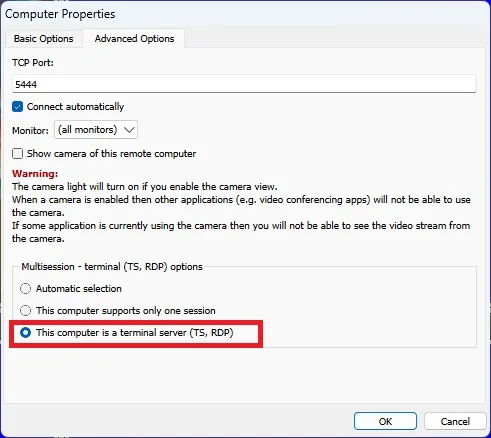
When adding server to console select Advanced Options and choose option This computer is a terminal server (TS, RDP):
Check one server with two student sessions
Illustrative setup: a Windows Terminal Services/RDP server named rdp-lab.school.example has two signed-in student accounts, student01 and student02. These names are placeholders, not a captured classroom result.
- Install the Windows Agent on the server with administrator rights and keep its service running. Install the Console on the teacher computer. Choose a reachable direct/VPN route or configure Cloud Connection.
- Add the server once using its address and Agent password. In
Advanced Options, enableThis computer is a terminal server (TS, RDP). - Sign in to the two student sessions. In the Console, expand the server's session entries and check the account names before opening each screen. The expected structure is one server with separately monitored sessions, not two separately installed Agents.
rdp-lab.school.example
  student01 — signed-in session
  student02 — signed-in session
If the server connects but a student is missing, confirm that the session is signed in, Agent service/version and multisession setting are correct, then inspect the Account filter. A filtered account is deliberately omitted. Check the specific session's status rather than assuming that a connected server proves every session can be captured. This example does not establish Windows edition support or licensing entitlements.