File Manager can be used to distribute lesson files and collect student work from student computers.
This feature allows the teacher to send files, collect finished assignments, copy files between folders, and delete files on selected student computers.
Typical use cases include:
- Sending worksheets or project files to all selected students.
- Collecting completed assignments at the end of class.
- Collecting logs or screenshots when a problem needs later review.
- Removing unauthorized files from lab computers.
Send Files Tab
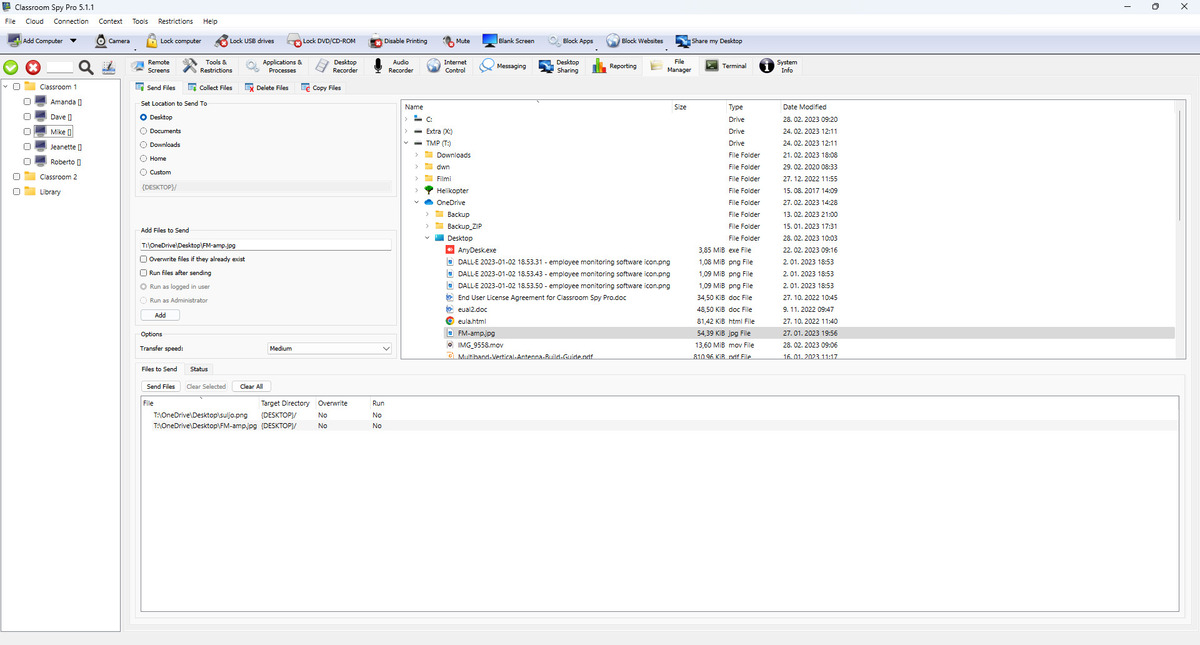
Upload one or more local files to selected student computers.
- Choose destination folder (Desktop/Documents/Downloads/Home/Custom) to decide where files are saved.
- Choose what should happen if a file with the same name already exists.
- Set transfer speed (Slow/Medium/Fast) to control how quickly files are sent.
- Run files after sending starts the file only after it is fully transferred.
- Run as Administrator runs the file with higher permissions; otherwise it runs as current user account.
- Status tab shows current progress and lets you stop selected transfers or all transfers.
Collect Files Tab
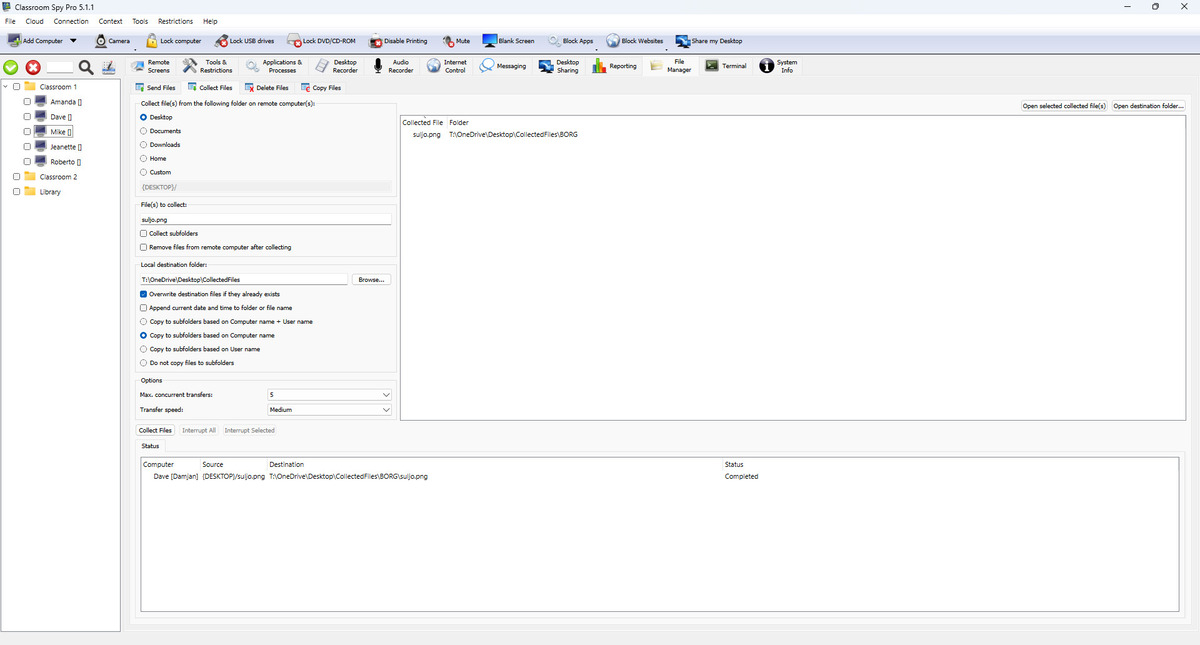
Download files from student computers to console storage.
- You can collect one exact file name or use file patterns (for example *.log).
- Use VSS helps copy files that are currently locked by another program (on supported systems).
- You can limit how many transfers run at the same time. Extra files wait and continue automatically.
- Choose how downloaded folders are organized: by computer, by user, by both, or flat in one folder.
- You can append date to file names, overwrite existing files, or remove remote files after collect.
If connection is interrupted, unfinished downloads continue after reconnect.
Delete Files Tab
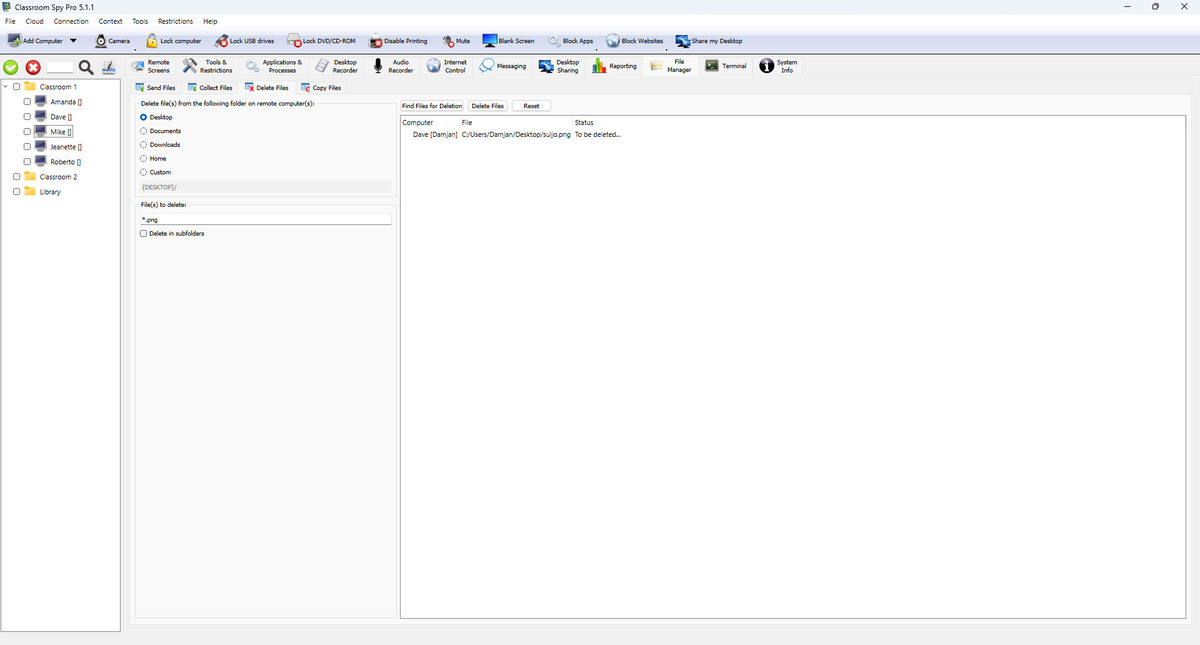
This tab uses a two-step safety flow: list first, then delete from confirmed list.
- Set source folder and file patterns.
- Run Find Files for Deletion to preview candidates.
- Execute Delete Files on the generated list.
Delete in subfolders also finds matching files inside subfolders before deletion.
Copy Files Tab
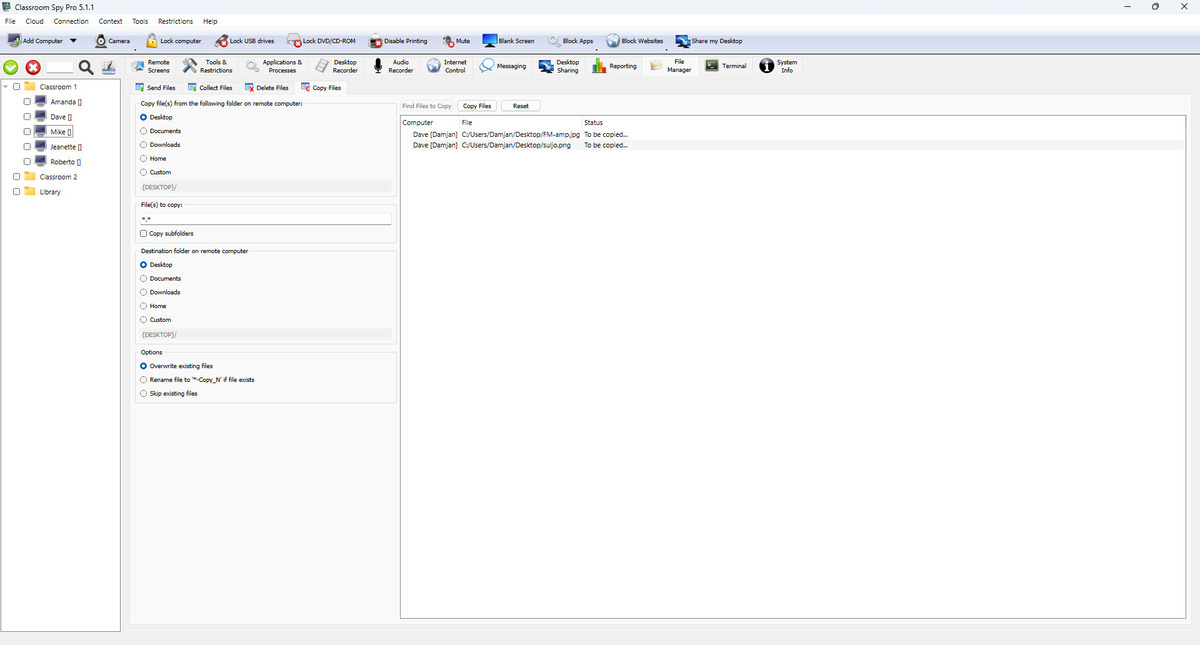
Copy files between folders on the same student computer.
- Choose source and pattern(s).
- Run Find Files to Copy to preview.
- Set destination and conflict mode (overwrite/rename/skip).
- Run copy action.
Conflict mode decides what happens if the target file already exists: overwrite replaces it, rename creates a copy with a new name, and skip leaves the existing file unchanged. VSS copy mode is available for locked files where supported.
Example: collect identically named assignments
Illustrative files: LAB-07/student07 and LAB-08/student08 each have Lab1.docx in Documents. Start with test files and keep the originals until collection is verified.
- Select the two computers. In Collect Files, choose Documents and enter
Lab1*.docxin File(s) to collect:. Leave Collect subfolders off for this flat example. - Choose a writable console destination, for example
C:\Classwork\Biology. Select Copy to subfolders based on Computer name + User name. Leave Append current date and time to folder or file name off to reproduce the paths below. - Leave Remove files from remote computer after collecting off. Start Collect Files, wait for completed transfer statuses and open each collected file to check its contents.
- The same filename is safe here because computer/user folders separate it. A second collection to the same path needs an explicit choice: keep the existing copy, enable Overwrite destination files if they already exists, or append the date/time to retain another collection.
C:\Classwork\Biology\LAB-07\student07\Lab1.docx
C:\Classwork\Biology\LAB-08\student08\Lab1.docx
The Send Files and Copy Files tabs have their own overwrite, rename and skip options. Those modes do not replace the grouping and overwrite controls in Collect Files. Avoid a flat destination when different learners submit the same filename.